12 Types of Farming With Examples: A Complete & Helpful Guide for Beginners
Published: 9 Dec 2025
Many beginners hear terms like organic farming, mixed farming, intensive farming, vertical farming, and feel confused. They wonder what each type actually means, how farmers use these methods, and which farming style is most profitable today. Some think modern farming is complicated, while others feel traditional methods are outdated. This article clears all confusion with simple explanations and real-world examples. By the end, you will clearly understand each type of farming and know exactly how they work in real life.
Subsistence Farming
Subsistence farming is when a farmer grows crops only for the family’s own use. The main goal is survival, not selling produce.
Features:
- Very small land area
- Basic tools
- Low investment
- Traditional seeds

Example: A small family in a village growing wheat, maize, and vegetables only for household consumption.
Benefits:
- Low cost
- Minimal risk
Limitations:
- No profit generation
- Limited crop variety
Commercial Farming
Commercial farming is large-scale production of crops for market sale. Farmers use advanced technology, irrigation systems, fertilizers, and machinery.
Features:
- High investment
- Large fields
- Modern equipment
- Yield-focused
Example: A commercial sugarcane farm growing thousands of tons for sugar mills.
Benefits:
- High profit
- Modern practices
Limitations:
- High cost
- Environmental pressure
Mixed Farming
Mixed farming combines crops and livestock on the same farm.
Features:
- Balanced income
- Natural recycling
- Better soil fertility
Example: A farmer growing maize while raising goats or cows on the same land.
Benefits:
- Reduced risk
- More income sources
Limitations:
- Needs management skills
Organic Farming
Organic farming avoids chemicals and focuses on natural inputs.
Features:
- Compost and manure
- Organic pest control
- Soil biodiversity
Example: A farm producing organic tomatoes using compost, neem spray, and mulching.
Benefits:
- Healthier produce
- Higher market prices
Limitations:
- Lower initial yields
- Requires careful planning
Intensive Farming
Intensive farming means producing maximum crop yield from small land using fertilizers, high-yield varieties, and irrigation.
Features:
- High input
- High labor
- Maximum output
Example: A high-density vegetable farm using hybrid seeds and daily irrigation.
Benefits:
- High yield
- Efficient land use
Limitations:
- Soil nutrient depletion
- Environmental pressure
Extensive Farming
Opposite of intensive farming, extensive farming uses large land with minimal input.
Features:
- Low labor
- Wide land area
- Low production costs
Example: Wheat farming on large open fields with low fertilizer use.
Benefits:
- Natural soil health
- Low cost
Limitations:
- Lower yield per acre
Nomadic Herding
Nomadic herding involves moving livestock from place to place in search of pasture and water.
Features:
- No permanent settlement
- Herd movement
- Seasonal grazing
Example: Shepherds moving goats or sheep across mountains for fresh pasture.
Benefits:
- Natural feeding
- Low cost
Limitations:
- Weather risks
- No stable income
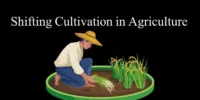
Shifting Cultivation
Shifting cultivation involves clearing a small forest area, farming for a few years, then moving to another area as soil nutrients decrease.
Features:
- Also known as slash-and-burn
- Short-term farming
- Minimal tools
Example: Tribal communities practicing slash-and-burn for crops like rice and millet.
Benefits:
- Low investment
- Natural soil recovery
Limitations:
- Environmental impact
- Low productivity
Plantation Farming
Plantation farming is large-scale cultivation of a single cash crop.
Features:
- Single crop focus
- Industrial scale
- Tropical regions
Example: Tea plantations, coffee estates, rubber plantations.
Benefits:
- High export value
- Skilled management
Limitations:
- Monoculture risks
- Seasonal dependency
Aquaponic Farming
Aquaponics combines fish farming and hydroponics.
Features:
- Soil-free
- Uses fish waste to fertilize plants
- Closed-loop system
Example: A farmer growing lettuce and raising tilapia in one integrated system.
Benefits:
- Zero waste
- Saves water
Limitations:
- High setup cost
- Requires technical knowledge
Hydroponic Farming
Hydroponic farming grows plants without soil, using nutrient-rich water.
Features:
- Indoor controlled environment
- Fast growth
- High-quality yield
Example: Hydroponic strawberry and lettuce farms in urban cities.
Benefits:
- 90% water savings
- No soil problems
Limitations:
- High maintenance
- Power dependency
Vertical Farming
Vertical farming grows crops in stacked layers using artificial lighting and climate control.
Features:
- Space-efficient
- LED lights
- Zero soil
Example: Vertical leafy green farms inside warehouses or containers.
Benefits:
- Year-round production
- Perfect for cities
Limitations:
- Very high setup cost
- Requires electricity
How to Choose the Right Type of Farming for Your Land
- Understand your soil texture to match it with suitable crops.
- Check sunlight exposure to know which areas get full sun or shade.
- Identify your water availability so you can choose farming types that fit your resources.
- Study your local climate and pick crops that survive your temperature range.
- Notice land size and slope because some farming systems need flat land while others work anywhere.
- Evaluate your budget to decide if you should start traditional, low-cost, or advanced farming.
- Start small and expand once you learn how your chosen method performs.
The Future of Farming and What Modern Growers Should Expect
- AI tools will detect diseases early, helping farmers save crops.
- Vertical and indoor farming will grow, especially in cities with limited land.
- Hydroponics and aquaponics will increase because they save water and boost yield.
- Smart irrigation systems will reduce water waste and improve efficiency.
- Climate-resilient seeds will help farmers handle heat, drought, and heavy rainfall.
- Solar-powered tools will cut electricity costs for small and large farms.
- Digital tracking systems will show consumers where their food comes from, building trust.
Conclusion
Farming has evolved into many different forms, each suitable for specific climates, goals, and resources. Whether it is traditional subsistence farming or modern vertical farming, every method has unique strengths and challenges. Understanding these 12 types helps beginners make smarter decisions, choose the right farming style, improve productivity, and adopt modern practices that support long-term sustainability. With the right method and proper planning, anyone can create a successful farming system.

Is Vertical Farming Healthy? A Complete, In-Depth Guide for Modern Consumers and Farmers



- Be Respectful
- Stay Relevant
- Stay Positive
- True Feedback
- Encourage Discussion
- Avoid Spamming
- No Fake News
- Don't Copy-Paste
- No Personal Attacks
- Be Respectful
- Stay Relevant
- Stay Positive
- True Feedback
- Encourage Discussion
- Avoid Spamming
- No Fake News
- Don't Copy-Paste
- No Personal Attacks
