Shifting Cultivation in Agriculture: Complete Steps and Cycle
Published: 15 Dec 2025
Shifting cultivation is one of the oldest agricultural practices known to humankind. Long before modern farming tools, fertilizers, and irrigation systems were developed, early communities depended on nature-driven farming methods to grow food. Shifting cultivation emerged as a practical solution in forested and hilly regions where permanent farming was difficult.
Many students and readers feel confused about this system: Why do farmers leave land after cultivating it? How does soil regain fertility without fertilizers? Is shifting cultivation harmful or sustainable? To clear these doubts, this article explains shifting cultivation in agriculture, focusing on its complete steps and cycle, in a simple, structured, and exam-friendly way.
So, guys, without wasting time, let’s jump into the article to learn the Shifting Cultivation in Agriculture: Complete Steps and Cycle
What Is Shifting Cultivation in Agriculture?
Shifting cultivation is a subsistence farming system in which farmers clear a piece of forest land, grow crops for a short period, and then abandon that land to allow natural regeneration. After leaving the land fallow for several years, farmers move to a new plot and repeat the same cycle.
This method is also called:
- Slash and burn agriculture
- Jhum cultivation
- Swidden agriculture
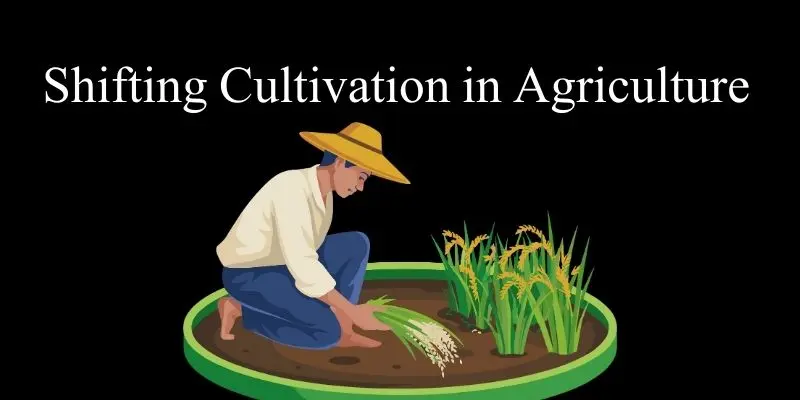
It is practiced in regions such as Northeast India, the Amazon Basin, parts of Africa, and Southeast Asia.
Why Shifting Cultivation Is Practiced
Shifting cultivation developed due to:
- Low population density
- Abundant forest land
- Limited farming technology
- Dependence on natural soil fertility
For many tribal and indigenous communities, it is not just a farming method but a way of life, deeply connected with culture, tradition, and survival.
Complete Steps of Shifting Cultivation in Agriculture
Shifting cultivation follows a fixed and continuous cycle. Each step has a clear purpose and directly affects the next stage.
Step 1: Selection of Land
The first step is the selection of a suitable piece of land.
Farmers usually choose:
- Forest-covered areas
- Sloping or hilly land
- Areas with dense vegetation
Reason for Land Selection
- Forest soil contains rich organic matter
- Decomposed leaves improve fertility
- Thick vegetation indicates good moisture and nutrients
Farmers rely on traditional knowledge, observing soil color, plant growth, and forest density rather than scientific soil tests.
Step 2: Clearing of Vegetation (Slashing)
Once the land is selected, the natural vegetation is cleared.
How Clearing Is Done
- Trees, bushes, and grasses are cut
- Simple tools like axes and knives are used
- Large trees may be cut partially or left standing
This process is known as slashing.
Purpose
- To create open land for crops
- To reduce competition for nutrients
- To allow sunlight to reach the soil
Step 3: Drying of Vegetation
After slashing, the cut vegetation is left on the land to dry.
Why Drying Is Important
- Dry vegetation burns easily
- Ensures complete burning
- Produces nutrient-rich ash
The drying period may last several weeks, depending on climate and rainfall.
Step 4: Burning of Vegetation (Burning Stage)
Burning is the most characteristic step of shifting cultivation.
Process of Burning
- Dried vegetation is set on fire
- Burning is usually controlled
- Done before the rainy season
Benefits of Burning
- Converts vegetation into ash
- Ash adds potassium and phosphorus to soil
- Kills pests and weed seeds
- Improves soil pH
Ash acts as a natural fertilizer, eliminating the need for chemical inputs.
Step 5: Cleaning and Preparation of the Field
After burning, farmers prepare the land for sowing.
Activities Involved
- Removing unburnt tree stumps
- Spreading ash evenly
- Making small planting spots
Unlike modern agriculture:
- No ploughing is done
- Soil structure remains undisturbed
- Soil erosion is reduced in the short term
Step 6: Sowing of Crops
Sowing is done manually, usually at the start of the rainy season.
Method of Sowing
- Small holes are made using sticks
- Seeds are placed by hand
- No machinery is used
Crops Grown
- Rice
- Maize
- Millets
- Pulses
- Vegetables
Mixed Cropping
Multiple crops are grown together to:
- Reduce risk of crop failure
- Improve soil health
- Ensure food security
Step 7: Crop Growth and Minimal Care
Shifting cultivation requires very little crop management.
Care Practices
- Occasional weeding
- Protection from wild animals
- No irrigation systems
- No chemical fertilizers
Rainfall provides water, while ash supplies nutrients. Farming depends largely on natural processes.
Step 8: Harvesting of Crops
Harvesting is done when crops mature.
Harvesting Features
- Done manually using sickles
- Crops harvested in stages
- Mainly for family consumption
There is limited surplus, and commercial sale is minimal.
Step 9: Decline in Soil Fertility
After one or two cropping seasons, soil fertility begins to decline.
Reasons for Decline
- Nutrients from ash are exhausted
- Continuous cropping reduces organic matter
- Weed growth increases
- Crop yield decreases
At this stage, farming becomes unproductive.
Step 10: Abandonment of Land (Fallow Period)
The cultivated land is then abandoned.
What Happens During Fallow Period
- Natural vegetation regrows
- Soil fertility is restored
- Forest ecosystem recovers
- Biodiversity returns
The fallow period may last 5 to 10 years in traditional systems, but it is shorter today due to population pressure.
Step 11: Shifting to New Land
Farmers move to a new forest area, and the entire process starts again. This continuous movement forms the shifting cultivation cycle.
Cycle of Shifting Cultivation (Summary)
- Selection of land
- Slashing of vegetation
- Drying of vegetation
- Burning
- Field preparation
- Sowing of crops
- Crop growth with minimal care
- Harvesting
- Decline in fertility
- Fallow period
- Shifting to new land
Advantages of Shifting Cultivation
- Low cost farming
- No chemical fertilizers
- Uses traditional knowledge
- Supports subsistence livelihoods
- Maintains crop diversity
Disadvantages of Shifting Cultivation
- Causes deforestation if fallow period is reduced
- Low productivity
- Soil erosion on slopes
- Not suitable for large populations
Conclusion
Shifting cultivation in agriculture is a traditional farming system based on natural soil regeneration. Its complete steps and cycle—from land selection to fallow period—show how early farmers worked in harmony with nature. Although it cannot meet the demands of modern large-scale food production, understanding shifting cultivation is essential for appreciating traditional agriculture, sustainability concepts, and the historical development of farming systems.
Importance of Harvesting in Agriculture: Why the Right Harvest Makes or Breaks Farming



- Be Respectful
- Stay Relevant
- Stay Positive
- True Feedback
- Encourage Discussion
- Avoid Spamming
- No Fake News
- Don't Copy-Paste
- No Personal Attacks
- Be Respectful
- Stay Relevant
- Stay Positive
- True Feedback
- Encourage Discussion
- Avoid Spamming
- No Fake News
- Don't Copy-Paste
- No Personal Attacks
