Ancient Farming Tools with Names: A Complete Guide to Early Agricultural Implements
Published: 16 Dec 2025
Long before tractors, harvesters, and modern machinery transformed agriculture, early farmers depended on simple yet highly effective tools made from stone, wood, bone, and later metal. These ancient farming tools played a vital role in shaping human civilization. They allowed people to move from hunting and gathering to settled agriculture, leading to the growth of villages, trade, and cultures.
Many students and readers wonder: How did ancient farmers cultivate land without machines? What tools did they use for ploughing, sowing, harvesting, and irrigation? Were those tools really effective?
This detailed article answers all these questions by explaining ancient farming tools with names, their structure, uses, and importance in early agriculture.
So, guys, without wasting time, let’s jump into the article to learn the Ancient Farming Tools with Names: A Complete Guide to Early Agricultural Implements
What Are Ancient Farming Tools?
Ancient farming tools are traditional agricultural implements used by early farmers to perform basic farming activities such as:
- Land preparation
- Sowing seeds
- Weeding
- Irrigation
- Harvesting
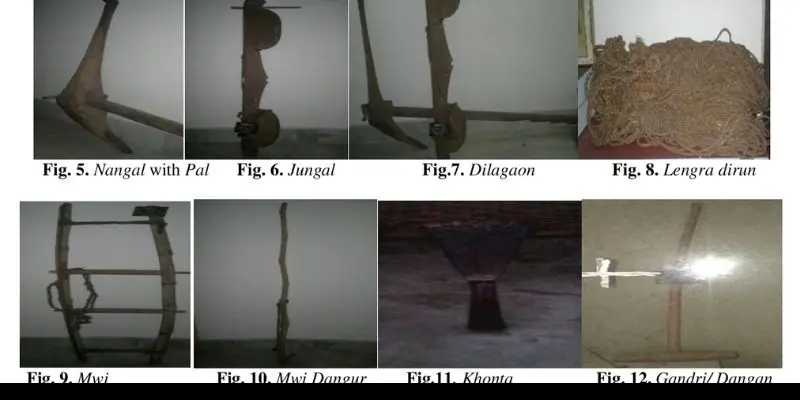
These tools were mostly hand-operated, animal-driven, and environment-friendly. Despite their simplicity, they laid the foundation of modern agricultural technology.
Importance of Ancient Farming Tools
Ancient farming tools were important because they:
- Increased food production
- Reduced human labor
- Allowed cultivation of larger areas
- Improved efficiency in farming
- Supported the rise of civilizations
Without these tools, organized agriculture would not have been possible.
Classification of Ancient Farming Tools
Ancient farming tools can be grouped based on their function:
- Tools for land preparation
- Tools for sowing
- Tools for weeding
- Tools for irrigation
- Tools for harvesting
- Tools for processing and storage
Each category is explained below in detail.
Ancient Tools Used for Land Preparation
1. Plough
The plough is one of the most important ancient farming tools.
Material:
- Initially made of wood
- Later fitted with iron tips
Uses:
- Loosening the soil
- Turning the soil
- Preparing land for sowing
How It Worked:
The plough was usually pulled by oxen or buffaloes. It broke the soil surface, allowing air and water to reach plant roots.
The invention of the plough marked the beginning of organized agriculture.
2. Hoe
The hoe is one of the oldest hand tools in farming.
Material:
- Stone or metal blade
- Wooden handle
Uses:
- Loosening soil
- Removing weeds
- Making shallow furrows
Hoes were especially useful in small farms and gardens where ploughs could not reach.
3. Digging Stick
The digging stick was a simple pointed wooden stick.
Uses:
- Digging holes
- Sowing seeds
- Uprooting plants
It was widely used during early agriculture before the invention of metal tools.
Ancient Tools Used for Sowing Seeds
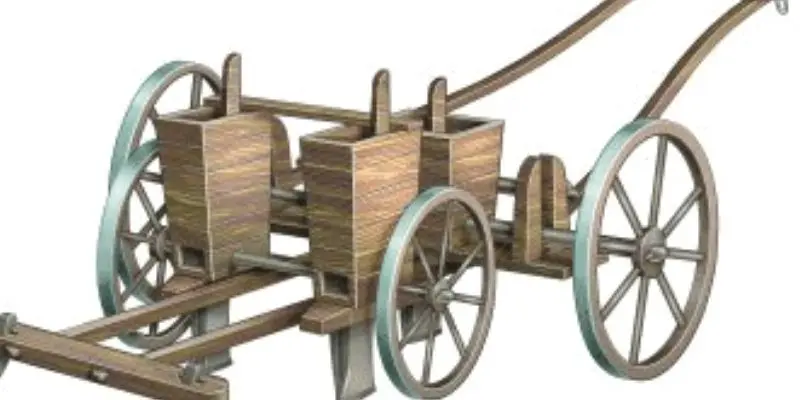
4. Seed Drill (Early Form)
An early version of the seed drill existed in ancient civilizations.
Uses:
- Dropping seeds at proper depth
- Maintaining spacing between seeds
This tool improved germination and reduced seed wastage.
5. Broadcasting Basket
Farmers used baskets or containers made from bamboo or reeds.
Uses:
- Scattering seeds by hand
- Used mainly for grains
Though simple, this method was effective for large open fields.
Ancient Tools Used for Weeding
6. Hand Hoe (Weeding Hoe)
This hoe had a narrow blade.
Uses:
- Removing weeds
- Aerating soil
- Protecting crops from nutrient competition
Manual weeding helped maintain crop health without chemicals.
7. Sickle-Shaped Weeder
A curved blade tool used to cut unwanted plants.
Uses:
- Cutting weeds close to the ground
- Cleaning crop rows
Ancient Tools Used for Irrigation

8. Shaduf
The shaduf was a traditional irrigation tool.
Structure:
- Long wooden pole
- Bucket on one end
- Counterweight on the other
Uses:
- Lifting water from rivers
- Irrigating fields
This tool was widely used in river valley civilizations.
9. Persian Wheel
The Persian wheel was an advanced ancient irrigation device.
Uses:
- Lifting groundwater
- Continuous water supply
It was operated by animals and greatly improved irrigation efficiency.
10. Water Pot and Channel System
Farmers used:
- Clay pots
- Small channels
Uses:
- Manual watering
- Directing water to crops
Ancient Tools Used for Harvesting
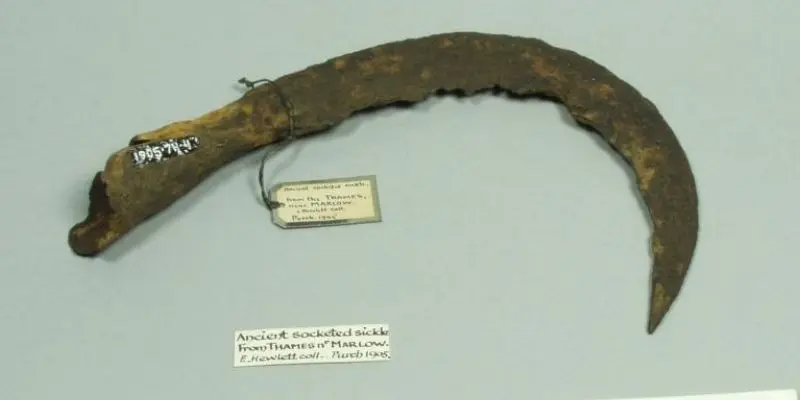
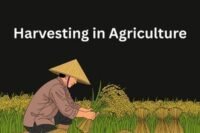
11. Sickle
The sickle is the most well-known harvesting tool.
Structure:
- Curved metal blade
- Wooden handle
Uses:
- Cutting crops like wheat and rice
- Harvesting grass and fodder
Its curved shape allowed quick and efficient harvesting.
12. Scythe
The scythe was larger than a sickle.
Uses:
- Harvesting large fields
- Cutting grass
It required skill but covered more area.
Ancient Tools Used for Threshing and Processing

13. Flail
The flail consisted of two wooden sticks joined together.
Uses:
- Separating grain from stalks
Farmers beat harvested crops to remove grains.
14. Mortar and Pestle
Uses:
- Grinding grains
- Processing seeds
This tool was common in early farming communities.
Ancient Tools Used for Storage
15. Granary
Granaries were built using:
- Mud
- Clay
- Wood
Uses:
- Storing grains
- Protecting crops from pests
Advantages of Ancient Farming Tools
- Environment-friendly
- Low cost
- Easy to repair
- Required no fuel or electricity
- Encouraged sustainable farming
Limitations of Ancient Farming Tools
- Required more labor
- Time-consuming
- Low productivity
- Not suitable for large-scale farming
Role of Ancient Farming Tools in Civilization
Ancient farming tools:
- Enabled food surplus
- Supported population growth
- Led to village settlements
- Encouraged trade and economy
- Laid foundation of modern agriculture
Comparison with Modern Farming Tools
| Ancient Tools | Modern Tools |
|---|---|
| Manual operation | Machine-driven |
| Low cost | High cost |
| Environment-friendly | Fuel-dependent |
| Low output | High output |
Conclusion
Ancient farming tools with names reflect the wisdom, creativity, and survival skills of early farmers. Though simple in design, these tools performed essential farming tasks effectively and sustainably. Understanding these tools helps us appreciate how agriculture evolved and how modern farming stands on the foundation built by ancient agricultural practices.




- Be Respectful
- Stay Relevant
- Stay Positive
- True Feedback
- Encourage Discussion
- Avoid Spamming
- No Fake News
- Don't Copy-Paste
- No Personal Attacks
- Be Respectful
- Stay Relevant
- Stay Positive
- True Feedback
- Encourage Discussion
- Avoid Spamming
- No Fake News
- Don't Copy-Paste
- No Personal Attacks
